Tokenising Nature-Based Credits for Global Markets
DLT-Powered Registry on Hedera for High-Integrity Environmental Assets
Challenge
Environmental credit markets are increasingly affected by fragmentation, limited transparency, and barriers to international trading. Existing registries are often siloed within individual jurisdictions or methodologies, making it difficult for buyers to verify the integrity of nature-based credits or move them efficiently between markets.
As a result, credit issuers struggle to demonstrate the rigour of their methodologies, while buyers — particularly corporate and institutional investors — face heightened due diligence costs and uncertainty around credit provenance, additionality, and chain of custody. This undermines confidence in nature-based credits and slows the flow of capital into critical ecosystems such as coral reefs and biodiversity-rich landscapes.
At the same time, environmental markets operators seeking to scale internationally face limited tooling to expose their credits to global liquidity, integrate with secondary marketplaces, and differentiate on the basis of integrity and traceability.
Solution
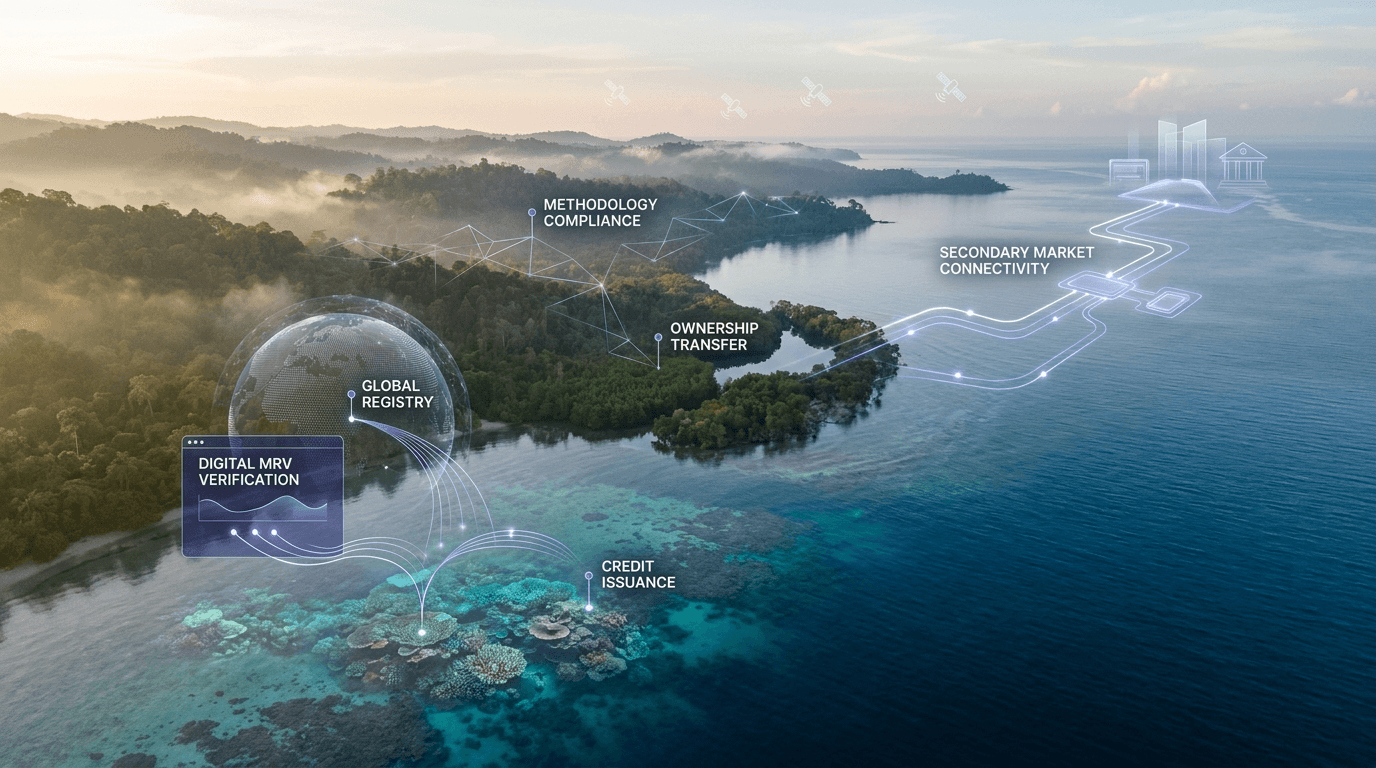
The solution introduces a verifiable digital registry for nature-based credits, enabling environmental markets operators to tokenise, verify, and trade high-integrity credits with end-to-end lifecycle traceability.
Using digital MRV workflows, decentralised identifiers (DIDs), and tokenised environmental credits anchored on Hedera, project data and credit issuance events are captured at source and recorded on-chain. Buyers, regulators, and marketplace participants can independently verify methodology compliance, ownership, and retirement status before transacting, supported by a web-based registry with role-specific interfaces for project developers, issuers, buyers, and auditors.
The platform integrates with existing environmental methodologies and exposes both primary marketplace functionality (direct credit sales) and secondary market connectivity through recognised tokenisation standards, enabling interoperability with global trading venues and institutional buyers.
Business Outcomes
By introducing verifiable identity and tokenisation into environmental credit markets, the solution delivers:
High-integrity, fully traceable credits with on-chain proof of methodology compliance and chain of custody.
Reduction in fraud and double-counting risk through cryptographically anchored issuance and retirement records.
New revenue streams through primary marketplace fees and secondary market connectivity.
Enhanced buyer trust and engagement from corporate and institutional participants.
Differentiation for environmental markets operators in a competitive global landscape.
Illustrative impact includes measurable uplift in credit pricing and accelerated time-to-market for new methodologies driven by automated, policy-based verification.
Technical Solution Overview
The solution leverages the EcoGuard platform, developed by The Hashgraph Group, in combination with the open-source Guardian framework as the core verification engine. Hedera Hashgraph distributed ledger technology enables the anchoring of decentralised identifiers (DIDs) and verifiable credentials (VCs), ensuring tamper-resistant, auditable, and privacy-preserving credit operations.
Environmental methodologies are codified into executable Guardian policies, enabling automated verification and credit minting. Project participants undergo onboarding and verification, receiving identity credentials stored in secure wallets. Authenticated project data is captured through decentralised identity protocols, validated against policy requirements, and bound to credit issuance events on-chain.
A web-based registry serves multiple stakeholder roles, with primary marketplace functionality for direct credit sales and secondary market connectivity for broader trading through recognised tokenisation standards (including IWA token standards). The architecture is designed to complement existing environmental market protocols while enabling cross-platform interoperability through W3C DIDs and VCs.
Unlike centralised environmental registries, the decentralised approach ensures that credits are portable, interoperable, and not controlled by a single entity, supporting scalable trust across methodologies, marketplaces, and jurisdictions.
Implementation Process
01
Development
Digitisation of environmental methodologies into Guardian policies, build-out of the dMRV infrastructure, and development of the registry platform with stakeholder-specific interfaces.
02
Pilot
Deployment for tokenisation of an inaugural credit type (reef credits), validating data collection, verification, and primary marketplace operations.
03
Launch
Commercial rollout with expanded methodology coverage, activation of secondary market integrations, and scaling to support the operator’s growth as a global leader in environmental digital assets.