Redefining Trust in Enterprise Voice Communications
Leveraging Hedera DLT and Decentralised Identity to Enable Verifiable, Secure, and Trusted Voice Interactions
Challenge
Enterprise voice communication is increasingly affected by fraud, impersonation, and declining trust. While existing frameworks such as STIR/SHAKEN verify the authenticity of phone numbers, they do not confirm the real-world identity of the caller.
As a result, recipients are unable to distinguish between legitimate and fraudulent calls, leading to low answer rates, poor customer engagement, and significant financial losses due to scams, the challenges that are now further exacerbated by AI-driven voice cloning.
At the same time, telecom operators and CPaaS providers struggle to differentiate their offerings in a commoditised market, with limited ability to monetise trust and security as premium services.
Solution
The solution introduces a verifiable identity layer for voice calls, enabling organisations to cryptographically prove their identity, and optionally the identity of individual agents, during call initiation.
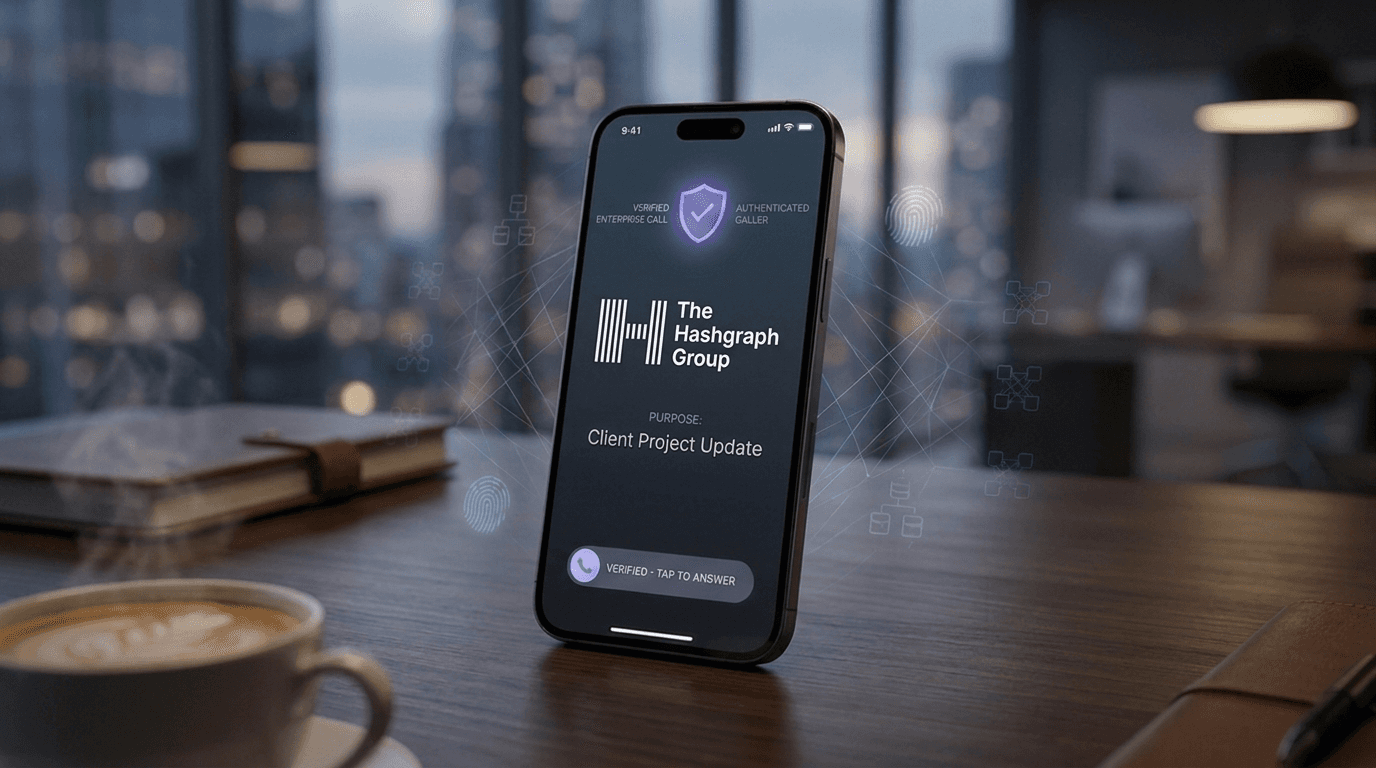
Using decentralised identifiers (DIDs) and verifiable credentials anchored on Hedera’s distributed ledger, enterprise identity is securely bound to phone numbers and embedded into the call setup process. This allows recipients to see verified information (such as organisation name, logo, and purpose of call) before answering, and optionally request real-time verification.
The solution integrates with existing telecom infrastructure and CPaaS platforms, augmenting standard voice services with a programmable trust layer that can be exposed via APIs.
Business Outcomes
By introducing verifiable identity into voice communications, the solution delivers:
Improved answer rates for legitimate enterprise calls.
Reduction in fraud and impersonation attacks, including AI-driven scams.
New revenue streams through premium verified calling and identity services offered as B2B services.
Enhanced customer trust and engagement.
Differentiation for telecom and CPaaS providers in a competitive market.
Illustrative impact includes measurable fraud reduction (e.g. 1–3%) and increased conversion or collection rates driven by higher call answer rates.
Technical Solution Overview
The solution leverages the Hedera DLT and IDTrust platform, developed by The Hashgraph Group, to anchor decentralised identifiers (DIDs) and verifiable credentials (VCs), ensuring tamper-resistant, auditable, and privacy-preserving identity verification.
Enterprise customers undergo onboarding and verification (KYB), receiving identity credentials stored in secure wallets. These credentials are dynamically attached to call metadata during call initiation via API integration with CPaaS or telecom platforms.
At call time, identity data is verified in real time against the ledger, ensuring authenticity, validity, and revocation status. Verified identity information is then delivered to the recipient via network signalling or application-layer integration, enabling enriched caller display prior to answering.
The architecture is designed to complement existing telecom protocols (e.g. SIP/IMS) and network APIs, while enabling cross-operator interoperability through standards-based identity frameworks (W3C DIDs and VCs).
Unlike centralised identity registries, the decentralised approach ensures that identity is portable, interoperable, and not controlled by a single entity, supporting scalable trust across networks and jurisdictions.
Implementation Process
01
Development
Design and integration of identity layer with voice infrastructure and APIs, including DID/VC issuance and verification mechanisms.
02
Pilot
Deployment with selected enterprise customers to validate technical integration, user experience, and business impact (e.g. answer rate uplift, fraud reduction).
03
Launch
Commercial rollout as a platform capability, enabling telecom operators and CPaaS providers to offer verified calling as a premium service.